What Is a Female Thread Coupling and How Does It Work?

Time:2026-09-10 Author:Aria
0%

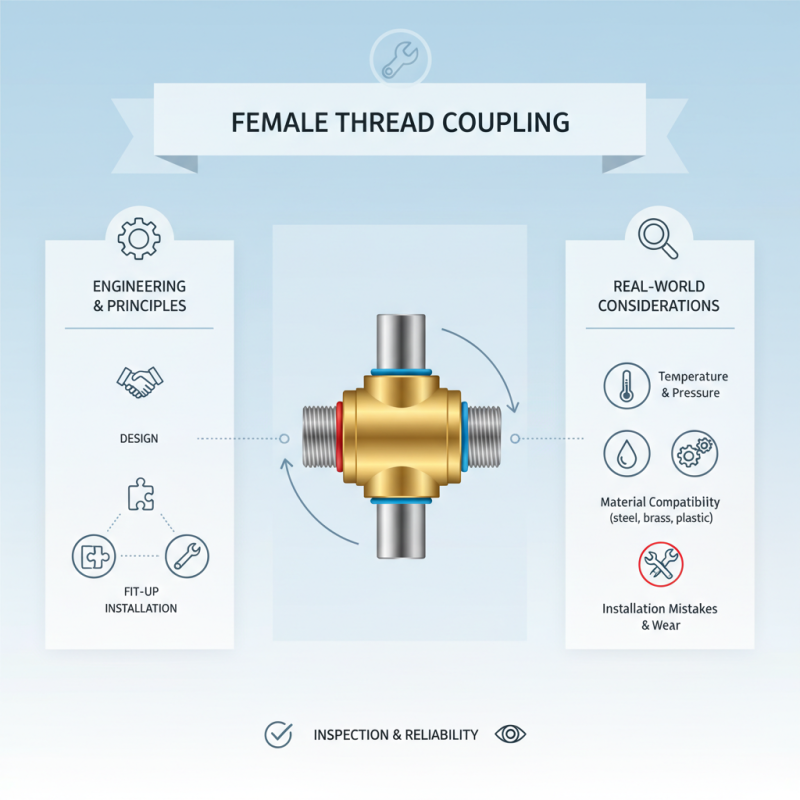
A Female Thread Coupling is a compact fitting with internal threads on both ends. It joins two pipes, tubes, or male-threaded components along the same flow path. Inside a workshop, it may look simple: two threaded openings, a short body, and a wrench-sized surface. The engineering is less obvious.

Piping engineer Roy A. Parisher offers a useful reminder: “A connection succeeds only when design, fit-up, and installation agree.” That principle explains how a Female Thread Coupling works. The internal threads engage the external threads on a pipe or nipple. As the parts tighten, their thread flanks create mechanical engagement. A sealant, gasket, or tapered thread design then helps control leakage. Threads alone are not always enough.

Small details matter. A dirty thread can damage the seal. Excessive torque may split a cast fitting. Insufficient torque can leave a visible leak path. Material compatibility matters too, especially when steel, brass, stainless steel, or plastic components meet. Temperature, pressure, vibration, and fluid type influence the final selection.

This guide examines what a Female Thread Coupling is, how its threads transfer force, and why sealing methods differ. It also considers common installation mistakes and practical inspection points. Not every coupling behaves identically. That is worth remembering.

Real systems are rarely perfect. Misalignment happens. Threads wear. Installers sometimes trust appearance too much. A reliable connection requires careful checking, not confidence alone.
What Is a Female Thread Coupling and How Does It Work?

Female Thread Coupling: Definition, Purpose, and NPS 1/8–4 Sizes

A female thread coupling is a short, hollow fitting with internal threads at both ends. It joins two pipes or fittings with male threads. The coupling keeps the connection aligned while allowing fluid or air to pass through the center. In practical installation work, it often helps extend a pipe run, replace a damaged section, or connect components with matching thread standards. It is usually straight, not directional.

The size range NPS 1/8–4 covers small instrument lines through larger service piping. NPS means Nominal Pipe Size, not the exact outside diameter. For example, a 1/2-inch pipe does not measure exactly 1/2 inch across. Thread design also matters. A coupling may use tapered threads for sealing or straight threads for mechanical joining with another sealing method. Always verify the drawing, material, pressure rating, and thread specification before installation. A small mismatch can cause leakage.

Tips: Clean the threads and inspect them under good light. Use a compatible sealant when the system requires it. Tighten firmly, but avoid excessive force, which can crack the fitting or damage the threads. I have seen installers trust size markings alone, and that is not enough. Checking thread form and engagement depth takes little time. It prevents a frustrating rework later.

What Is a Female Thread Coupling and How Does It Work? — Female Thread Coupling: Definition, Purpose, and NPS 1/8–4 Sizes
NPS Size Approx. DN NPT Threads per Inch Thread Pitch Reference Male Thread Major Diameter Female Coupling Function
1/8 DN 6 27 0.941 mm 0.405 in (10.3 mm) Joins two small NPT male pipe ends or fittings in a straight line.
1/4 DN 8 18 1.411 mm 0.540 in (13.7 mm) Provides a compact threaded connection for instrument, pneumatic, or fluid-service piping.
3/8 DN 10 18 1.411 mm 0.675 in (17.1 mm) Connects two compatible 3/8 NPT male components without changing direction or size.
1/2 DN 15 14 1.814 mm 0.840 in (21.3 mm) A common general-purpose size for joining threaded pipe, valves, and fittings.
3/4 DN 20 14 1.814 mm 1.050 in (26.7 mm) Creates a female-to-female connection between two 3/4 NPT male ends.
1 DN 25 11.5 2.209 mm 1.315 in (33.4 mm) Used for connecting one-inch threaded pipe sections or male fittings.
1-1/4 DN 32 11.5 2.209 mm 1.660 in (42.2 mm) Joins larger threaded piping while maintaining the same nominal pipe size.
1-1/2 DN 40 11.5 2.209 mm 1.900 in (48.3 mm) Provides a straight female-thread connection for 1-1/2 NPT male pipe or fittings.
2 DN 50 8 3.175 mm 2.375 in (60.3 mm) Connects two two-inch NPT male ends in process, utility, or industrial piping.
2-1/2 DN 65 8 3.175 mm 2.875 in (73.0 mm) Used where a larger straight threaded connection is required for compatible NPT components.
3 DN 80 8 3.175 mm 3.500 in (88.9 mm) Joins two three-inch NPT male components and supports a larger nominal flow path.
3-1/2 DN 90 8 3.175 mm 4.000 in (101.6 mm) Provides a female threaded connection for compatible 3-1/2 NPT male ends.
4 DN 100 8 3.175 mm 4.500 in (114.3 mm) Connects two four-inch NPT male pipe ends in a straight-through configuration.
How it works: A female thread coupling has internal tapered pipe threads. The external NPT threads of the mating pipe or fitting engage with these internal threads; tightening increases thread interference and creates a pressure-resistant joint when an appropriate thread sealant is used. NPS sizes are nominal designations, not direct measurements of the coupling’s outside diameter. Thread data above are NPT reference values; actual coupling length, wall thickness, outside diameter, pressure rating, and material depend on the applicable product standard and service requirements.

Thread Standards: NPT ASME B1.20.1, BSPT, and ISO 7-1 Profiles

A female thread coupling joins two male-threaded pipes or fittings, but its performance depends on matching the thread standard. NPT follows ASME B1.20.1 and uses a 60-degree thread angle with a 1:16 taper. Its crests and roots are slightly flattened. The tapered shape tightens as the male thread enters the coupling. A suitable thread sealant is normally required.

BSPT uses a 55-degree Whitworth profile, with rounded crests and roots. Its taper is also commonly 1:16. ISO 7-1 defines related sealing profiles, including R external tapered threads, Rc internal tapered threads, and Rp internal parallel threads. An Rc female coupling is designed to engage an R male thread. An Rp profile is different and may require a sealing element rather than thread interference alone. Small profile differences matter.

NPT and BSPT can appear compatible at first glance. They are not interchangeable. The thread angle, pitch, and crest shape may prevent full engagement. Leakage can follow. A practical inspection should verify the marking, pitch, gauge fit, and visible thread condition. Remove burrs before assembly. Avoid forcing a mismatched fitting with excessive torque. That mistake is common. It can damage both parts.

Field conditions also influence selection. Temperature changes, vibration, fluid pressure, and pipe material affect the joint. Thread sealant should suit the conveyed medium and operating temperature. Standards provide the geometry, but correct installation provides reliability. Even a clean-looking coupling deserves a second check.

How Tapered Threads Engage to Form a Mechanical Seal

A female thread coupling receives a tapered male pipe thread and connects two threaded components. Its internal diameter narrows gradually toward the coupling’s center. This geometry creates controlled interference as the male thread advances. The fit becomes tighter with every turn. Not perfectly airtight.

For common NPT connections, ASME B1.20.1 specifies a 1:16 taper, equal to 3/4 inch per foot. ISO 7-1 uses the same 1:16 taper for several pressure-tight pipe threads. These figures matter because even a small machining error changes contact pressure. The threads seal mainly along their flanks and crests. A suitable sealant fills microscopic spiral gaps, scratches, and tool marks. Without it, fluid may follow the thread path like water along a screw.

In practical assembly, the installer should clean both parts and inspect damaged crests under strong light. The male thread should enter smoothly by hand before tightening with a wrench. Excessive torque can split a thin coupling or distort the thread profile. ASME B1.20.1 provides dimensional requirements, but field performance also depends on material, temperature, vibration, and pressure cycling. A 2023 industrial maintenance survey reported that leakage remains among the most frequent causes of unplanned piping intervention. That finding deserves caution, because survey methods vary. Still, it supports routine inspection. Marking the final wrench position can reveal gradual loosening during service.

What Is a Female Thread Coupling and How Does It Work?

A female thread coupling has internal threads that receive a male threaded pipe or fitting. In tapered systems, the male and female thread profiles become progressively tighter as they engage. The resulting interference creates the mechanical contact needed for a pressure seal, while an approved thread sealant can fill the small helical clearance between the threads.

The chart compares the included thread angles and nominal taper used by common tapered pipe thread systems. NPT uses a 60° thread angle, while ISO 7-1 and BSPT use a 55° Whitworth-form thread angle. These systems commonly use a 1:16 taper, equal to approximately 1.79° per side.

Reference standards: ASME B1.20.1 for NPT and ISO 7-1 for pressure-tight tapered pipe threads. ISO 228-1 parallel pipe threads are not included because they do not seal by taper interference.

Installation Steps: Inspect, Apply Sealant, Tighten, and Leak-Test

What Is a Female Thread Coupling and How Does It Work?

A female thread coupling joins two male-threaded pipes or fittings. Its internal threads create a mechanical connection. Installation starts with inspection. Check the coupling, pipe threads, and sealing face for cracks, dents, dirt, or damaged threads. ASME B1.20.1 provides dimensional guidance for many inch-based pipe threads, while ISO 7-1 addresses pressure-tight joints made on threads. These standards do not replace careful field judgment.

Clean threads matter. Apply a sealant approved for the fluid, temperature, and pressure. Use only enough to cover the male threads, leaving the first thread mostly clear. Excess sealant can enter valves or narrow passages. Start the coupling by hand. It should turn smoothly for several rotations. Stop if it binds early. A wrench can then tighten the joint, but avoid excessive force. Overtightening may split the coupling or distort the threads. I still recheck this step, because “tight” often feels safer than it is. It is not always safer.

After assembly, pressurize the system gradually and inspect the joint. Use an approved leak-detection solution or a calibrated test method. Never rely on sound alone. The U.S. Department of Energy reports that compressed-air leaks can waste 20–30% of compressor output in many facilities. A small coupling leak can therefore become an operating cost. Record the test pressure, duration, and result. If bubbles appear, depressurize safely, remake the joint, and test again. Do not simply tighten a leaking connection under pressure.

Materials and Pressure Classes: ASME B16.11 Class 2000–6000

A female thread coupling is a forged fitting with internal threads at both ends. It connects two male-threaded pipes, valves, or nipples. The threads create a mechanical joint, while sealant fills small spiral gaps. Correct engagement matters. Too little engagement can leak or strip.

ASME B16.11 Class 2000, 3000, and 6000 describe pressure classes for threaded forged fittings. They are not simple pressure limits for every service. Temperature, pipe size, material group, wall thickness, and fluid conditions also affect allowable pressure. A Class 6000 coupling generally has heavier construction than a Class 2000 fitting. However, higher class does not automatically make it suitable for every system.

Common materials include forged carbon steel, stainless steel, and alloy steel. Carbon steel often suits general process piping and moderate temperatures. Stainless steel helps resist corrosion, especially in wet or chemically aggressive service. Alloy steel may be selected for elevated temperatures or demanding mechanical conditions. Check the material specification, heat treatment, thread standard, and marking before installation. Small details matter.

Do not rely on appearance alone. A thick coupling can still be the wrong choice. Field inspection should confirm NPS size, pressure class, material traceability, and compatible male threads. Sealant selection also deserves attention. Some sealants soften, contaminate, or fail under heat. The practical mistake is assuming Class 6000 means unlimited pressure. It does not. Even experienced installers can overlook temperature derating or thread damage.

FAQS

: What is a female thread coupling?

: It joins two male-threaded pipes, valves, or nipples. Internal threads create the mechanical connection. Sealant fills small spiral gaps.

What should I inspect before installation?

Check the coupling, pipe threads, and sealing surfaces for cracks, dents, dirt, or damaged threads. Small defects matter. Do not trust appearance alone.

How should the threads be cleaned and sealed?

Clean the threads thoroughly. Use sealant approved for the fluid, temperature, and pressure. Cover the male threads lightly, leaving the first thread mostly clear.

How do I start tightening the coupling?

Start the coupling by hand. It should turn smoothly for several rotations. Stop if it binds early. Cross-threading can damage both parts.

Can excessive tightening cause problems?

Yes. Excessive force may split the coupling or distort the threads. “Tight” is not always safer. I still recheck this step.

What do pressure classes mean?

Pressure classes indicate a fitting’s general pressure category. They are not universal pressure limits. Temperature, material, size, wall thickness, and fluid conditions also matter.

Which materials are commonly used?

Carbon steel suits many general services. Stainless steel offers better corrosion resistance in wet environments. Alloy steel may suit higher temperatures or demanding mechanical conditions.

How should the completed joint be tested?

Pressurize the system gradually. Use an approved leak-detection solution or calibrated method. Record pressure, test duration, and results. Never rely on sound alone.

What should I do if bubbles appear?

Depressurize the system safely. Remake the joint and test again. Do not tighten a leaking connection under pressure. That shortcut can make things worse.

Conclusion

A Female Thread Coupling is a pipe fitting designed to join two components with externally threaded ends, creating a continuous flow path in systems using NPS 1/8 through 4 sizes. It is commonly manufactured with internal threads that follow recognized profiles such as NPT under ASME B1.20.1, BSPT, or ISO 7-1. Selecting the correct thread standard is essential because profile, pitch, and taper must match for proper engagement.

Tapered threads gradually tighten as they are assembled, allowing the mating surfaces to create a mechanical seal. For reliable installation, inspect the coupling and pipe threads, clean away debris, apply a compatible sealant when required, tighten to the appropriate level, and perform a leak test. Material selection should reflect the operating environment, temperature, and media. For demanding pressure applications, couplings may be specified in ASME B16.11 Class 2000, 3000, or 6000 ratings, provided the entire piping system is designed and installed accordingly.

Aria

Aria

Aria is a dedicated marketing professional with a deep passion for innovative strategies and a keen understanding of our company's product offerings. With a wealth of experience in the industry, Aria excels at crafting engaging content that highlights the unique features and benefits of our......